In this dialogue
How do I hold my sword in Pflug?
I know Vom Tag and Ochs now. How do I hold my sword in Pflug – and where does that name come from?
Perhaps the position resembles the way you hold a plough. That is one explanation for the name, but it is not certain. For now, what matters is how you stand in it. Pflug is one of the lower guards. It is one of the simplest positions, yet it is very versatile.
Take your sword in both hands: as usual, your right hand grips directly below the crossguard, while your left loosely holds part of the pommel.
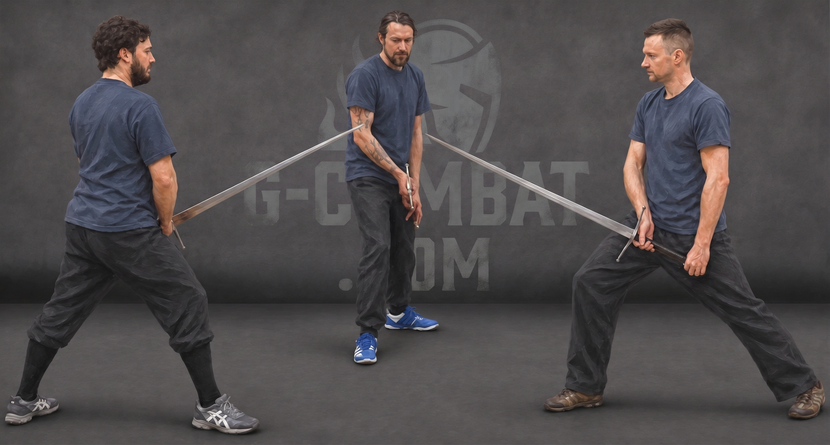
With your right foot forward, hold the sword on your left hip side. Keep your hands to that side, a little in front of your hip and away from your body. Keep your elbows relaxed. The hilt – the grip area together with the crossguard and pommel – is roughly at hip height. The point, also called the Ort, faces your opponent’s face.
With your left foot forward, hold the sword on your right hip side instead. The principle stays the same: hands low and to the side, point towards your opponent. In Pflug, too, right and left refer to the side on which you hold the sword.
Why does the point face my opponent?
My point faces my opponent in Ochs too. What changes when I point it at them from Pflug?
Pflug also creates a direct threat. Your point faces your opponent, and you can thrust along a short path from there. You do not first need to draw back for a big cut.
Imagine someone swinging a sword at you from the side. A whole blade moves across your field of vision. It is comparatively easy to notice: something is coming.
With a thrust, however, you are looking almost along the blade. You mainly see the point coming towards you. It is much harder to judge how quickly it is approaching and how close it already is. A small movement can turn into a rather unpleasant surprise.
If your point faces off to the side of your opponent, you have to realign it before you can thrust directly. You give away the short path this guard offers.
The point has a second job, too. From this position, you can make contact with the opposing blade. We call that blade contact a bind. Later, you can use it to gain information about their movement and influence their blade. We will work on that so-called feeling in the bind later.
How do I combine Pflug with steps?
Do I change hip sides with every full step – and what path does the sword take?
Exactly. Start with your right foot forward and your sword near your left hip. Take a full step forwards, and your left foot ends up in front. At the same time, bring your sword directly across to your right hip side. On the next full step, change back again.
Unlike our change between the two Ochs positions, this is not yet an attack. To begin with, you are simply changing the side of your guard.
Can I combine that change with an attack?
Yes. Again, start with your right foot forward in left Pflug. As you step forwards, send the point straight ahead and extend your arms. This takes you into Langort, or long point: an extended position in which your point still faces your opponent.
Once you have completed the step, draw the sword back to your right hip side. Your left foot is now forward, and you have arrived in right Pflug.
The simple change of sides becomes a short exercise: Pflug – thrust into Langort – Pflug on the other side.
Try both versions slowly on your own first, with plenty of clear space: start with the direct change of sides and full steps, then add the thrust in between. Thrust forwards deliberately, then deliberately return to the guard.
Which mistakes can I spot myself?
What mistake do you see most often in beginners?
At first, the point angles slightly upwards towards your imagined opponent’s face. Then you take two or three steps – and the point sinks lower and lower, until it almost faces the floor.
You concentrate on your feet and forget your opponent. That is normal, but you need to train that attention too: imagine someone standing opposite you and keep directing your point towards them. After a step, check not just where your feet are, but where your point is facing.
The second common mistake is that your hands drift further and further forwards from the hip side. Eventually, you are holding the sword out in front of you with your arms stretched far forwards, rather than staying in Pflug.
You may know this image from the cinema: two opponents stand with their weapons extended, their blades touching, and then comes a threatening line of dialogue. In film and theatre, that serves a purpose. We show the audience tension, intention or emotion. As a fight choreographer, I use those moments myself.
But a position that tells a story serves a different purpose from a position in fencing. That dramatic pause gives your opponent time to react to your extended weapon and arms. In Pflug, we therefore want to keep the hands near the relevant hip side.
Do not confuse that with our thrusting exercise: there, you deliberately extend your arms into Langort and then draw the sword back into Pflug. Letting your hands drift forwards unnoticed as you walk is something else.
Contact Henrik directly
Stuck on a movement or have a specific training question? Message me directly. I can give you a quick assessment by message. If you want to go deeper, review your technique on video or work one-on-one in the gym, we’ll put together a coaching package that fits.