In this dialogue
What are Huten?
I can keep the distance in the partner exercise now. But how do I hold my sword when we start fencing?

This is where Huten — guards — come in. In the fencing books, you'll also find them called Lager or Leger. These are positions from which you can attack or defend. Almost any position your sword takes can be a starting position like this. To begin with the Liechtenauer tradition, we practise four principal guards: Vom Tag, Ochs, Pflug and Alber.
Ochs and Pflug — Ox and Plough? Where do those names come from?
They do sound rather strange at first. There are different views on where the names come from. For training, it's enough to connect the name with the position. When I say “Vom Tag” in the hall, you should know straight away which position I mean. We'll add other guards later.
Once I'm in a guard, do I wait for the other person to attack?
You may recognise this scene from sword-fighting films: two fencers face each other in impressive positions, waiting for the other one to attack and make a mistake. When we fence in the Liechtenauer tradition, you usually stay in a guard for only a second or two. Then you change to another one. If an opportunity to attack comes sooner, or you need to defend, you can act directly from the guard. We practise moving smoothly between the four principal guards in the Hutenlauf — a flowing guard exercise.
How do I stand in Vom Tag?
Show me Vom Tag. Where are my hands, and which way does the blade point?
Put your right foot forward. Your right hand grips directly below the crossguard, while your left hand loosely holds the pommel. Then raise both hands above your head. The sword points diagonally backwards, at roughly 45 degrees. That's the overhead version. Give someone a sword for the first time and say, “Make a cut from above,” and they'll usually wind up just like this.
There's also a version above the shoulder that we use often. Hold the sword just above your right or left shoulder, leaving a little space. In a third version, your hands are beside your head, again on either the right or the left. In all three versions, the point clearly faces backwards.
The 45 degrees are a guide. In some historical drawings, the sword is held a little steeper. Above all, check where the point is facing. Vom Tag looks quite aggressive. When someone stands in front of you like that, your immediate thought is: They're about to cut.
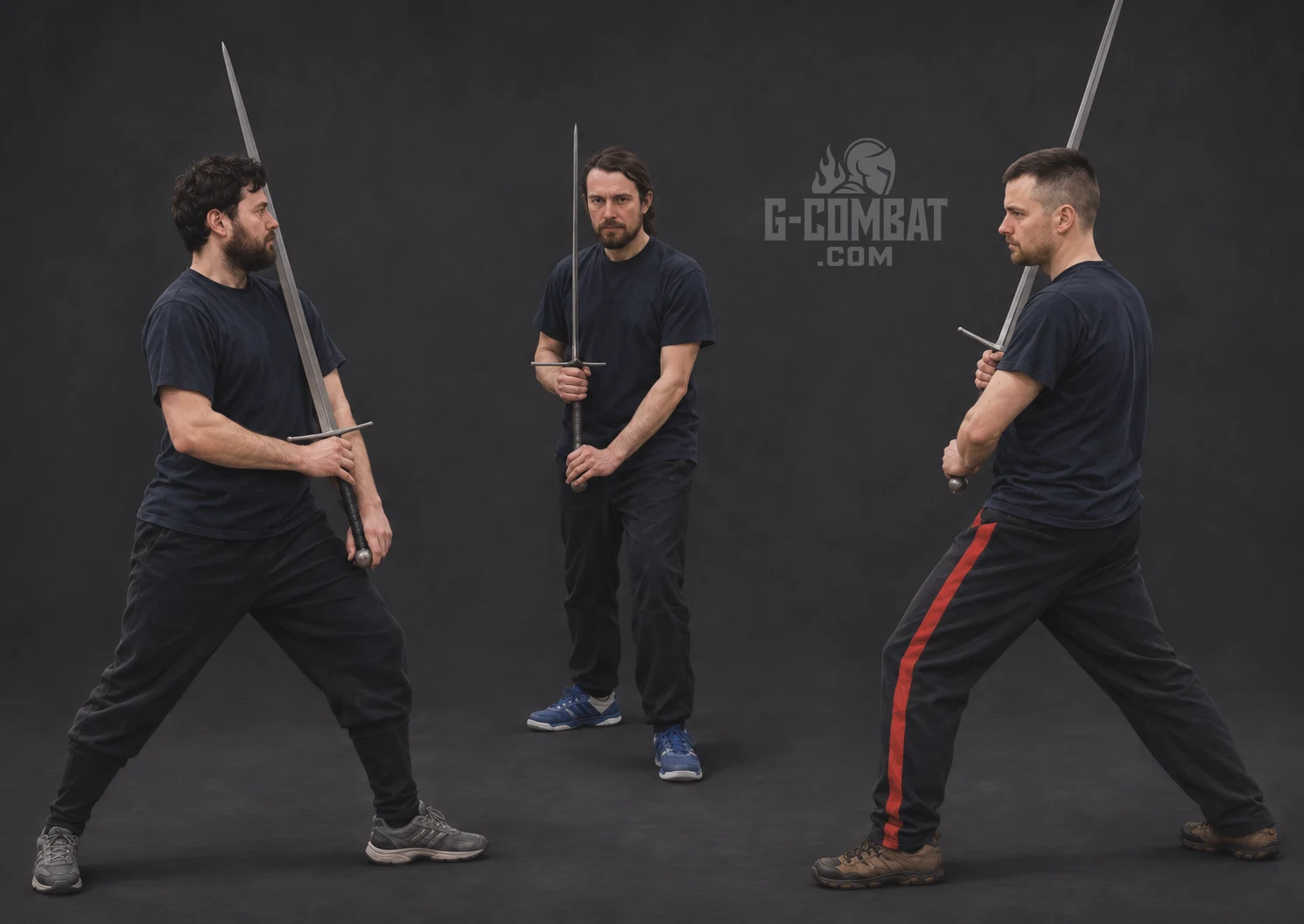
The shoulder version of Vom Tag. For the following exercise, raise your hands above your head.
What should I practise first?
What should I practise from Vom Tag first?
Stand on a line in the hall with your right foot forward and take the overhead Vom Tag. Now take a full step forward. Keep your hands and sword up. Then try a half step, and a following step too if you already know it. Move forwards and backwards along the line like this. The finishing touch is being able to move sideways while keeping the sword steady in the guard. You learn to control your feet independently of your upper body, hands and sword.
Do I stay in the guard that long when I'm fencing too?
In fencing, a second or two is often enough. As soon as I raise my hands, the other fencer thinks: Here comes a cut. Perhaps I really will cut. Perhaps I want them to react to the threat and attack first. That's what I mean by an invitation. Using it deliberately is a topic of its own. For this exercise, it's enough to move freely while keeping your sword steady in the guard.
Next, we look at Ochs.

Contact Henrik directly
Stuck on a movement or have a specific training question? Message me directly. I can give you a quick assessment by message. If you want to go deeper, review your technique on video or work one-on-one in the gym, we’ll put together a coaching package that fits.