In this dialogue
Source comparison
Historical material for comparison. The English passages below render Henrik Gyarmati’s modern German versions; they are not new translations made directly from the manuscripts. Manuscript names and folio references have been retained from the earlier CODEX. A fresh check of every folio against the facsimiles is still outstanding. These passages are presented separately from Henrik’s teaching practice.
1. MS 3227a
(14v) Together along a cord, or together as if carefully measured or weighed… He must therefore cut quickly and directly at the person, at the head or body — always at the nearest and quickest opening he can find and reach, and preferably with one blow rather than four or six that achieve nothing.
2. MS 3227a
(16r) You should also always prefer the upper opening to the lower one, and enter above his hilt with cuts or thrusts, skilfully and swiftly. For it is much easier to reach someone above the hilt than below it, and in this way all fencing is also much safer for you. Touching an upper opening is much better than touching a lower one.
3. MS 3227a
(16r) Know also that you should always come from the right side in your fencing, because from there you can get at him better in all matters of fencing or wrestling than directly from the front.
(19v) He also means that you should not simply follow the cut straight in with your step, but move aside and circle around, so that you come to his side, where you can engage him in many ways rather than from the front.
(18v) Hear what is poor: do not fence high from the left if you are right-handed. And if you are left-handed, you also fare poorly from the right.
(19v) Note and understand: when he says, “If you wish to see the art,” he means that a skilful fencer should put the left foot forward and cut from the right side. Directly at the person, with driving cuts, until you see where you can reach him well with your steps. And Liechtenauer means that, if you wish to fence strongly, you should fence from the left side with your whole body and all your strength, at the head and body wherever you can hit.
4. MS Dres.C. 487
(14r) Hear what is poor: do not fence high from the left if you are right-handed. And if you are left-handed, you also fare poorly from the right.
(14r–14v) This passage addresses left- and right-handed fencers. Understand it like this: when you approach in the Zufechten, if you are right-handed and want to strike the person, do not make your first cut from the left. It is weak, and you cannot withstand him if he binds strongly against it. Therefore cut from the right: then you can work strongly and skilfully at the sword as you wish. Likewise, if you are left-handed, do not cut from the right. It is very awkward to make a left-hander cut from the right, just as it is to make a right-hander cut from the left.
5. MS Germ.Quart.2020
(1r) Hear what is poor: do not fence high from the left if you are right-handed. And if you are left-handed, you also fare poorly from the right.
(10r–10v) Note that the first art of the longsword is, above all, to learn what correct cuts are, if you wish to fence strongly against others. Understand it like this: if you stand with your left foot forward and cut from your right side, but do not follow the cut with a forward step of your right foot, the cut is wrong. Your right side stays behind, so the cut becomes too short and cannot take its proper course to the other side, down in front of your left foot. Likewise, if you stand with your right foot forward and cut from the left without following the cut with your left foot, the cut is also wrong. Therefore remember: when you cut from the right, always follow the cut with your right foot. Do the same when you cut from the left. This brings your body properly into balance, making your cuts long and correct.
6. MS 3227a
(34v) Cut an Oberhau directly at him, shooting your point in towards his side above the hilt, so that you strike precisely into that small hole or window between the edge and the hilt.
(25v) And he should cast or shoot his point above the hilt towards the hands.
(26v) Send it in above the hilt with the point; shoot straight in together with the Krumphau from above downwards.
(28v) Make the Schilhau long enough and shoot the point firmly, otherwise you will be hindered by Durchwechseln.
Henrik’s teaching text
The Hau — cut — is one of the Drey Wunder, the “Three Wonders”. In simple terms, it is a blow delivered with the weapon.
We distinguish two cuts: the Oberhau, a descending cut, and the Unterhau, a rising cut. All other cuts are variations of these two.
- An Oberhau travels from above downwards, regardless of what it hits.
- An Unterhau travels from below upwards, regardless of what it hits.
A Mittelhau, a horizontal cut, is barely described, if at all, in the German school. Ideally, a cut lands with the outer third of the blade, nearest the point. Think more of the sword falling down onto the target than of a slicing action. The point takes a straight, short path towards the opening. The action is less circular than you often see. Rather than simply swinging the sword, you send the point flying towards the opening.
This comes from the hands working in opposite directions. In an Oberhau, the front right hand pushes while the rear left hand pulls. The right arm extends, and the left arm draws in.
In Ernstfechten — fighting in earnest — you do not wind the sword up before striking. The cut comes directly from wherever the blade is, or from the guard you are in. An extra wind-up is unnecessary. If you wind up for a cut, you signal what is coming and give your opponent time to prepare.
In the German school, the lower openings play no role as attacking targets. MS 3227a recommends attacking the upper openings. The shoulder and upper arms are alternative targets when the head cannot be reached.
An attack should therefore come from the right side rather than directly from the front. The sword should not enter straight into the opponent head-on, but more or less from the right towards the left. If the cut is directed straight at the opponent, take a step out to the side at the same time.
This instruction appears in many places in MS 3227a. A cut is combined directly with a thrust. The combination of cutting and “shooting the point” occurs not only with the two master cuts referred to here, but with many cuts. Shooting the point is not limited to acting from a bind once blade contact has been established. In our practice, we combine shooting the point with a lunge.
Context for the retained wording
The original statement that lower openings play no role is broader than the source preference for upper openings quoted alongside it, and sits beside the four-openings model. That difference remains visible here: the blanket statement is not an independently verified historical finding. The descriptions of Mittelhau and “shooting the point” are likewise retained as Henrik’s earlier teaching account.
Teaching images
Meyer · Unterhau — rising cut
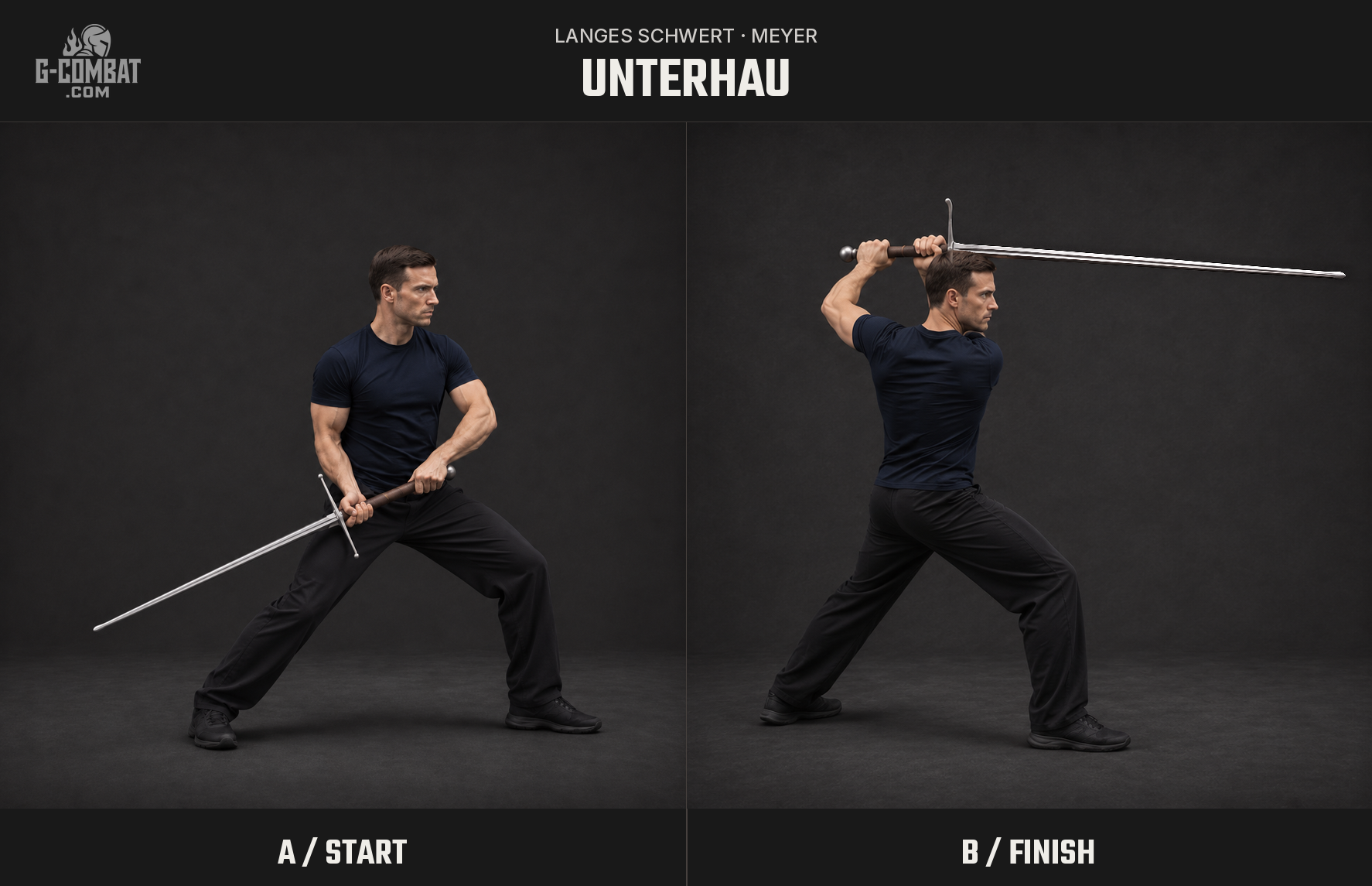
AI illustration based on a demonstration photograph by Henrik Gyarmati.

Contact Henrik directly
Stuck on a movement or have a specific training question? Message me directly. I can give you a quick assessment by message. If you want to go deeper, review your technique on video or work one-on-one in the gym, we’ll put together a coaching package that fits.