In this dialogue
Source comparison
Historical material for comparison. The English passages below render Henrik Gyarmati’s modern German versions; they are not new translations made directly from the manuscripts. Manuscript names and folio references have been retained from the earlier CODEX. A fresh check of every folio against the facsimiles is still outstanding. These passages are presented separately from Henrik’s teaching practice.
1. MS 3227a
(15v) Know also that, when fencing another person, you should pay close attention to your steps and be secure in them, as if properly balanced on a scale, stepping backwards or forwards according to what you have felt, supple and agile, swift and quick.
(18r) Remember this: all things have length and measure.
(22v) Whatever you do or begin, always keep measure and length. As soon as you gain the first strike, do not make it so violent or forceful that you can no longer make the following strike. This is why Liechtenauer says, “Remember this: all things have length and measure.” Understand the same of steps and all the other techniques and principles of fencing.
(18v) If you wish to see the art, go left and right with cuts, and left with right, so that you fence strongly.
(19v) Note and understand that, when he says, “If you wish to see the art,” he means that, if you want to fence skilfully, you should put your left foot forward and cut from the right side. Directly at the person with three cuts, until you see where you can get at him and reach him well with your steps. Liechtenauer also means that, if you wish to fence strongly, you should fence from the left side with your whole body and all your strength, at the head and body wherever you can hit. He also means that you should not simply follow the cut straight in with your step, but move a little aside and circle around, so that you come to his side, from where you can attack and press him in many ways rather than from the front.
(15v) You should also keep measure in your fencing according to the situation. Do not step so far that you cannot securely recover another step backwards or forwards as the situation requires. Two short steps often serve better than one long one. Sometimes a step to the left with short steps is needed; sometimes a good long step or a leap is needed.
2. MS Dres.C. 487
(11v–13r) Note that the first lesson of the longsword is to learn to cut correctly from both sides if you want to fence strongly and properly against another person. Understand it like this: if you want to cut from the right, make sure your left foot is forward. When you make the Oberhau from the right, follow the cut with your right foot. If you do not, the cut is wrong, because your right side stays behind. The cut becomes too short and cannot take its proper course down to the other side in front of your left foot. Likewise, if you cut from the left without following the cut with your left foot, that cut is also wrong. Therefore remember: whichever side you cut from, follow the cut with the foot on that same side. In this way, you can perform all your techniques correctly with (…) strength. All the other cuts should be made in the same way.
3. MS Germ.Quart.2020
(7v) Note that the first art of the longsword is, above all, to learn to cut correctly if you want to fence strongly against others. Understand it like this: if you stand with your left foot forward and cut from your right side, but do not follow the cut with the advance of your right foot, the cut is wrong. Your right side stays behind, so the cut becomes too short and cannot take its proper course down to the other side in front of your left foot. Do the opposite from the left side; this should happen together in all cuts and steps.
Henrik’s teaching text
These are basic considerations on stance and steps in historical fencing.
Good footwork is an important prerequisite for a fencer. Unfortunately, the sources say little or nothing about exactly how to place the feet.
The basic stance in the German school as taught at Drey Wunder is as follows. The front leg is the supporting leg and carries 60–70% of the weight; the angle between thigh and lower leg is no more than 45 degrees. The rear leg is bent. The upper body is upright. The feet are staggered in a stable three-point stance. The position is aggressively oriented forwards and optimised for very fast lunges.
Practice guide
Gradus Primus
Perform all the step types forwards and backwards with a sword in your hand.
- Full step — ganzer Schritt
- Half step — halber Schritt
- Crossing step — Kreuzschritt
- Following step — Nachstellschritt
- Switching step — Wechselschritt
- Lunge — Ausfall
- Extended lunge — erweiterter Ausfall
- Double step forwards — Doppelschritt vorwärts
- Double step with a turn — Doppelschritt mit Wendung
- Triple step forwards (LM) — Trippelschritt vorwärts (LM)
Gradus Secundus
Devise and practise combinations of two or three step types. Perform the chosen steps smoothly, without pausing, forwards or backwards, or combining both directions. Increase the speed. All step types are allowed.
Gradus Tertius
Follow the same approach as Gradus Secundus, but with a sword in your hand. Add suitable guards or movement sequences. You can also combine the exercise with flowering. The steps must still remain clear, recognisable and correctly performed.
Mobility and explosive movement
Gradus Primus
Choose a fixed mark on the floor. Start with both feet at that mark. The aim is to take an explosive step forwards or backwards, choosing any step type. One of your feet must always return to the central mark. Several steps can flow into one another. Changes of direction are also possible.
Gradus Secundus
“Reversing”: from the basic stance, take a step forwards or backwards as quickly as possible, then return to your original position within a very short time. The choice of step is open. This simulates withdrawing after an attack, or attacking after a defensive movement backwards — for example, Nachreisen, following after. Keep your stance clean and stable.
Context for the retained wording
The weight distribution, knee angle and three-point stance belong to Henrik’s teaching instructions from that period. The former organisation’s name in the teaching text identifies its original context. Gradus Primus already mentions a sword, and Gradus Tertius mentions it again: this overlap has been retained without inventing a new exercise to resolve it.
Teaching images
Full step · A / B
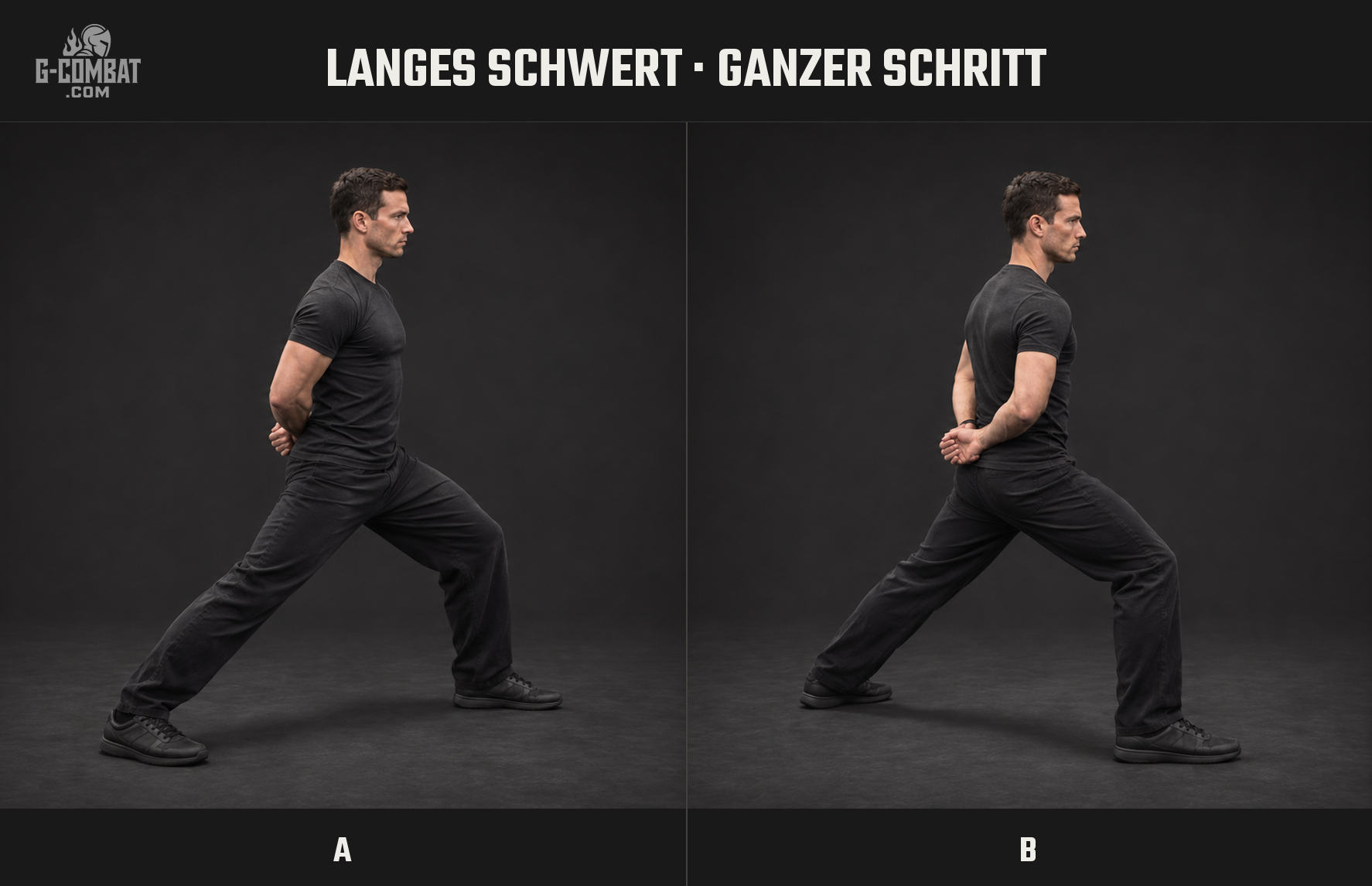
AI illustration based on a demonstration photograph by Henrik Gyarmati.
Lunge · A / B
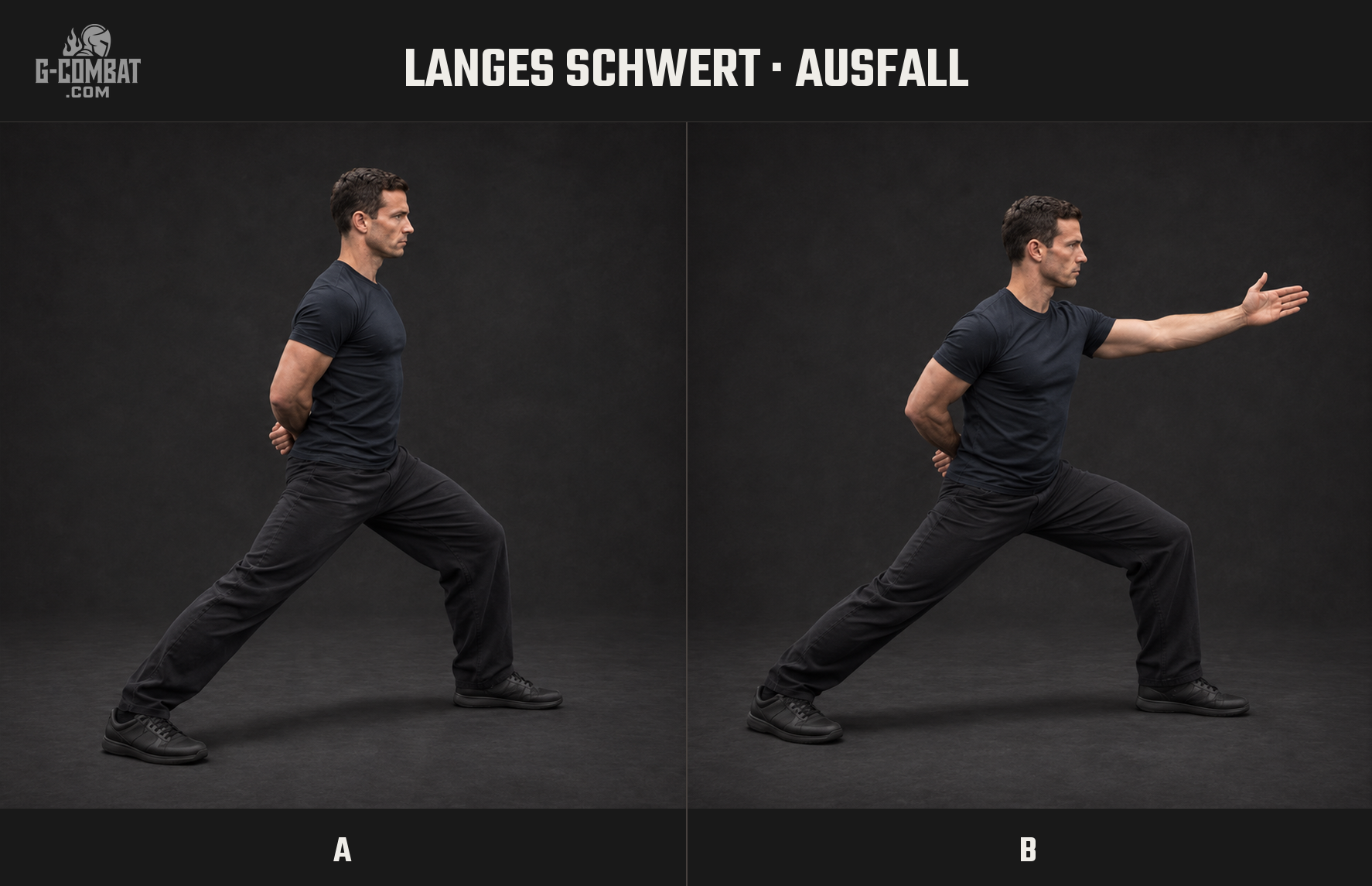
AI illustration based on a demonstration photograph by Henrik Gyarmati.

Contact Henrik directly
Stuck on a movement or have a specific training question? Message me directly. I can give you a quick assessment by message. If you want to go deeper, review your technique on video or work one-on-one in the gym, we’ll put together a coaching package that fits.