In this dialogue
Where does the point face in Ochs?
I know Vom Tag now. How do I hold the sword in Ochs?
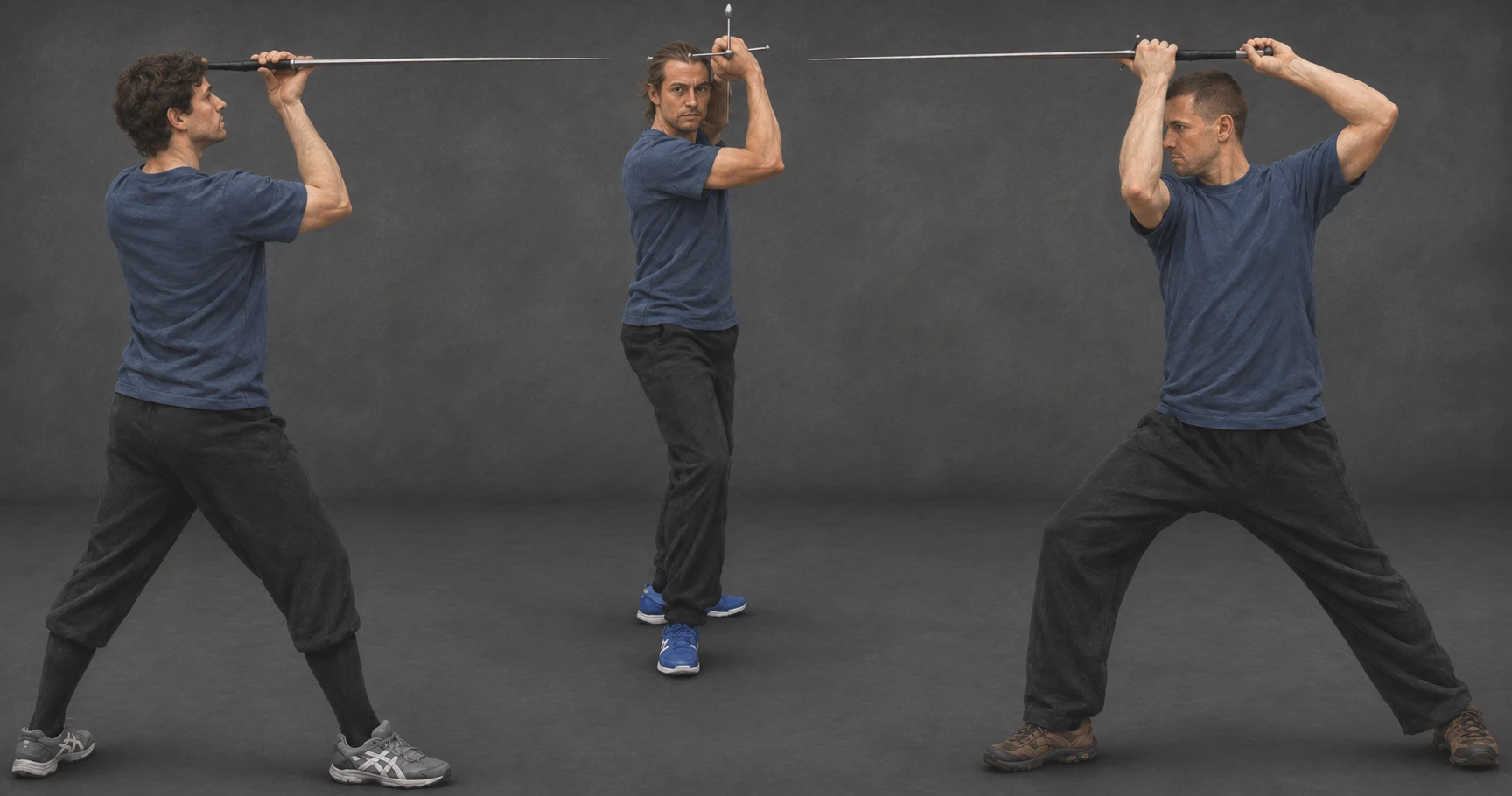
Hold the sword beside or in front of your head. The point, which we also call the Ort, faces the other person's face. Your right thumb supports the flat of the blade from underneath. The edges face sideways, and the crossguard is roughly parallel to the floor.
The position looks a little like an ox with its horns. Whether that's really where the name comes from isn't certain. For now, the important thing is that the point faces the other person. It looks quite threatening.
What is the difference between right and left Ochs?
What do I do with my feet? Are my arms crossed?
For our beginner exercise, hold right Ochs with your left foot forward. Your hands and sword are beside the right side of your head. Your forearms are crossed.
In left Ochs, your right foot is forward. Hold your hands and sword beside the left side of your head. Your forearms are not crossed. Right and left refer here to the side on which you hold the sword.
How do I change sides with a full step?
If I take a full step forward from right Ochs, my right foot ends up in front. Do I simply carry the sword across to the other side?
You could, but it isn't particularly economical. To begin with, we do it like this: start in right Ochs, left foot forward. Take a full step forward to bring your right foot to the front. At the same time, circle the sword above your head and finish in left Ochs. Your hands are now beside the left side of your head, and your forearms are no longer crossed.
The sword's point makes a full 360-degree turn. Imagine a clock lying roughly parallel to the floor. Your partner is at twelve o'clock, and that's where the point faces at the start. It travels backwards through nine, six and three, then returns to twelve. That's a memory aid for the circular movement, not an angle measurement.
Is that already an attack, or just a change of guard?
With the right intention and force, that rotating movement becomes a Twerhau — a transverse cut. That's what's exciting about the guards: moving from one to the next can itself be an attack. We'll look at how to hit with control later. For now, you're learning the movement and where it ends.
How do I know I've finished correctly?
What should I watch for as the change gets faster?
You need to stop the circling movement at the right moment. At the end, your point faces your partner's face again. As the change becomes more dynamic, it's easy to swing too far and let the point drift sideways.
Why is it so important for the point to face my partner again?
Because it threatens them directly there. From Ochs, you can make a short, direct thrust at any time. In a historical fight with real stakes, that could stop or seriously injure an opponent. We practise it with the appropriate control in training.
That's why we let the point leave that threatening alignment only briefly during the change, then bring it straight back. Your partner then has to deal with your blade. This also leads us towards fencing in the bind, which we'll cover later. For this exercise, remember: complete the circle, finish in Ochs, point towards your partner again.
Try it
Practise the change slowly on your own at first, with plenty of clear space around you. Start in right Ochs, combine the circle with a full step forward and stop in left Ochs. Check your front foot, the side your hands are on and the direction of the point. A controlled finishing position matters more than speed.
You can find the starting position in Guards and Vom Tag.
Contact Henrik directly
Stuck on a movement or have a specific training question? Message me directly. I can give you a quick assessment by message. If you want to go deeper, review your technique on video or work one-on-one in the gym, we’ll put together a coaching package that fits.