In this dialogue
Am I not leaving myself completely open in Alber?
In Ochs and Pflug, my point faces my opponent. In Alber, it faces down. Why would I hold my weapon like that – am I not leaving myself completely open?

Well spotted. You create an opening: a part of your body that your weapon is not currently covering.
In our teaching, Alber is a more defensive guard. That does not mean you cannot attack from it. But we use it particularly for a prepared defence and the blade contact that follows.
Imagine your opponent thinking: the top is completely open – I can just cut at it! That may be exactly the reaction you want to provoke. You offer an apparently easy opportunity and have your response ready. We call that an invitation.
The position may look a little foolish. Whether that is actually where the name comes from is uncertain. Do not let appearances fool you: an obvious opening can be part of a plan. Experienced fencers use this guard too, including in competition. What matters is knowing what you intend to do with the attack you expect.
How do I take up Alber?
Where do I hold the sword, and which foot goes forward?
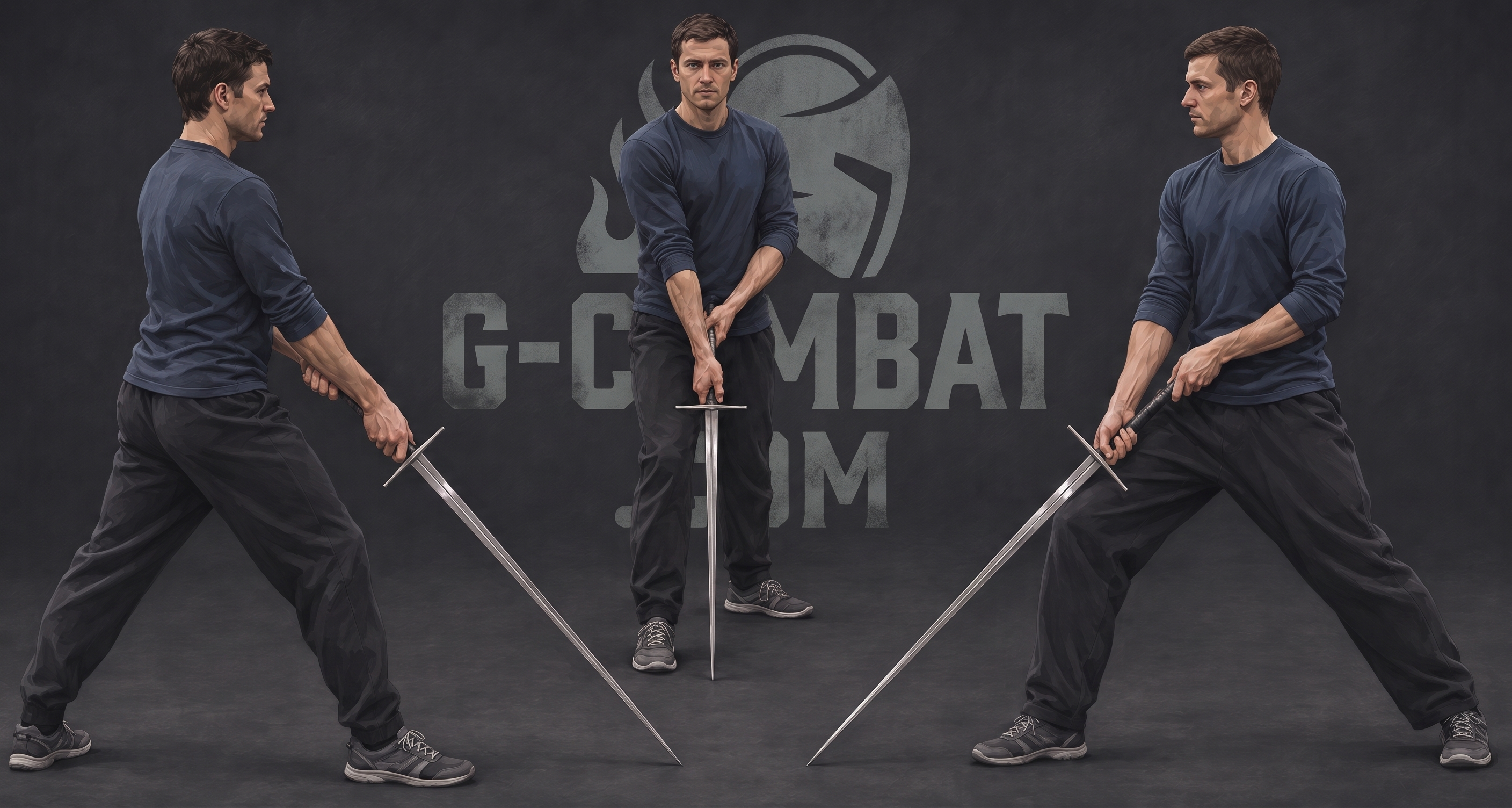
Hold the sword low and centrally in front of your body with both hands. Keep your arms relaxed and almost straight. The point faces diagonally forwards towards the floor.
Having your right or left foot forward does not change this basic position. You do not have to move the sword to the other hip side with each step as you do in Pflug.
What should I practise first?
Do I just move with steps to begin with, or do we add a defence straight away?
Start with steps alone. Take up Alber and move forwards and backwards along a line. Use the steps you already know: full steps, half steps, and later following steps or crossing steps. You do not need to know them all straight away.
Then move off the line and sideways as well. We do not add a defence to this first task yet. Next, we connect the four main guards in Hutenlauf, a moving guard exercise.
What is Hutenlauf?
Does that mean moving through the four positions one after another as I walk?
Exactly. You “walk” the guards and combine them with the steps you already know. We begin with two versions.
First, choose a fixed order: which guard comes first, second, third and fourth? Keep that order to begin with. Take a full step with each change and make sure you take up the next guard on the appropriate side. That way, you do not also have to decide what comes next at every step.
And once I can follow that order confidently?
Then mix the four guards freely. Change the order on each round. Later, add half steps and other familiar steps.
This is where it gets interesting: some transitions happen almost by themselves. With others, you suddenly notice: I need to guide my hands differently here, or adjust my movement. That is exactly what you should discover. Pay attention to how your body, hands and changes of sides feel. You are getting to know the paths between the positions.
From the outside, it may look a little like a form from an Asian martial art. You may know the Japanese term kata: a set sequence of movements that often also represents a fight against imagined opponents.
Our Hutenlauf is a teaching exercise for practising historical guards and their transitions. We choose an order for the exercise or arrange it freely.
And this is by no means just for beginners. People who have trained with us for ten or twelve years still practise their Hutenlauf. As a warm-up, a little fitness exercise, and a way of making their movement with the sword more fluid.

Contact Henrik directly
Stuck on a movement or have a specific training question? Message me directly. I can give you a quick assessment by message. If you want to go deeper, review your technique on video or work one-on-one in the gym, we’ll put together a coaching package that fits.