In this dialogue
What did you buy?
I bought a sword at a medieval market. I'd like to learn how to use it. Where do I start?

First, show me what you bought. Is it meant for one hand? Is there room for both hands on the grip? And is the sword suitable for practice at all? For your first exercises, I'd use a blunt trainer designed for the purpose.
How do I hold the longsword?
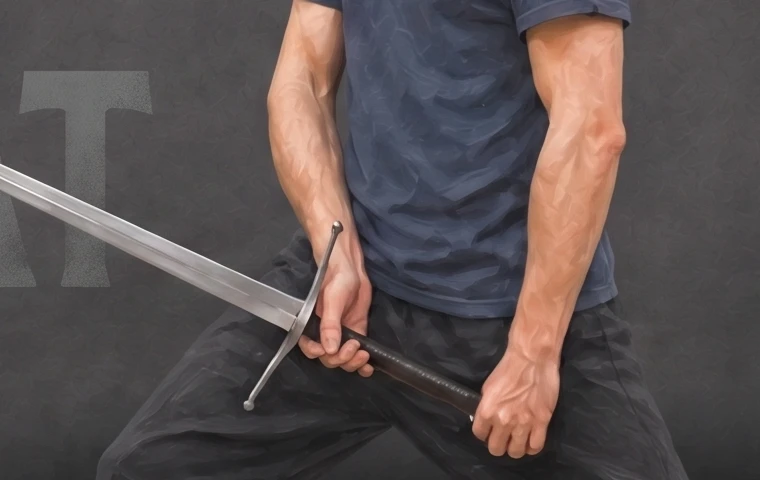
Let's say I have a longsword. Where do my hands go?
If you lead with your right hand, grip directly below the crossguard with that hand. Your left hand sits further down, sometimes partly on the pommel, depending on the grip. The right hand leads; the left helps steer. Clench hard with both hands and you'll soon notice that the sword becomes harder to control. With a one-handed sword, I'd start with your stronger hand and stick with that side for now.
What should I practise first?
And what should I practise with it first?
Put your right foot forward and your left foot back. Keep your stance relaxed. Now make a slow diagonal cut from high on your right to low on your left. Notice how your body moves with it, and check whether you can keep the blade on its line. Then try the other diagonal, from high on your left to low on your right. Picture an X. Keep the blade clear of your front knee.
When do I add steps?
When do I add the steps?
Once I can see you repeating the cutting line with control without stepping. Now put your left foot forward and bring the sword to your right shoulder. Take a full step forward with your right foot while cutting from high on your right to low on your left. Then lift the sword again, beside your left shoulder. Now your left foot takes a full step forward as you cut from high on your left to low on your right. Follow both cuts through to the end.
What are the basic guards for?
And why do I need those basic positions I see in the CODEX?
We call them Huten — guards. Think of a guard as a position you can move straight on from. As you practise, pay attention to how you flow from one position into the next.
What am I missing when I practise alone?
What am I missing if I practise on my own for now?
Above all, another person who changes the distance. In fencing, we call that distance Mensur. People practising with a weapon for the first time often move closer than they need to. That's why I have two people move slowly forwards and backwards under supervision while their training blades remain lightly crossed. One leads; the other keeps the distance. You'll notice straight away whether you can follow the movement or are getting too close. Beforehand, we agree on the pace and protective equipment.
Does it have to look like a film?
Does it eventually have to look like a film?
Think about what you want to learn it for. If you want to fence historically, we look at what the sources show and how the movement works in fencing. If you're working for a camera, on stage or in front of an audience, there's another question: what should the audience see and understand at that moment? That also shapes how you present the same movement.
Longsword
Here, longsword means the sword you practise with in both hands. One hand grips near the crossguard, the other further down the handle.
Full step — ganzer Schritt
In a full step forwards, your rear foot passes your front foot. The foot that was behind is now in front. In this dialogue, the lead changes from left to right and back again on the next step.
Huten — guards
Positions from which you can attack, defend or move to another guard. We begin with Vom Tag, Ochs, Pflug and Alber.
Mensur — fencing distance
The distance between you and your partner. You learn to judge it through partner exercises and check it at the contact point of the blades.
Contact Henrik directly
Stuck on a movement or have a specific training question? Message me directly. I can give you a quick assessment by message. If you want to go deeper, review your technique on video or work one-on-one in the gym, we’ll put together a coaching package that fits.