In this dialogue
Which foot do I move back?
In the first distance exercise, I simply followed my partner. Now they sometimes approach with a full step and sometimes with a half step. Which foot do I move back each time?
Try to mirror them. If they approach with a full step, take a full step back. Move your front foot behind the other foot. For both of you, the foot in front changes.
If they approach with a half step, take only a half step back yourself. Your rear foot moves back first; then your front foot follows. The same foot stays in front.
How do I recognise the right distance?
And how do I know whether I've kept the distance?
Look at your swords. Are the blades still touching at roughly the same place as in the first exercise? On both blades, the contact point is about two-thirds of the way from crossguard to point.
You don't need to get it right to the centimetre. If the blades suddenly cross in the middle, you're too close. If only the very tips touch, you're too far apart.
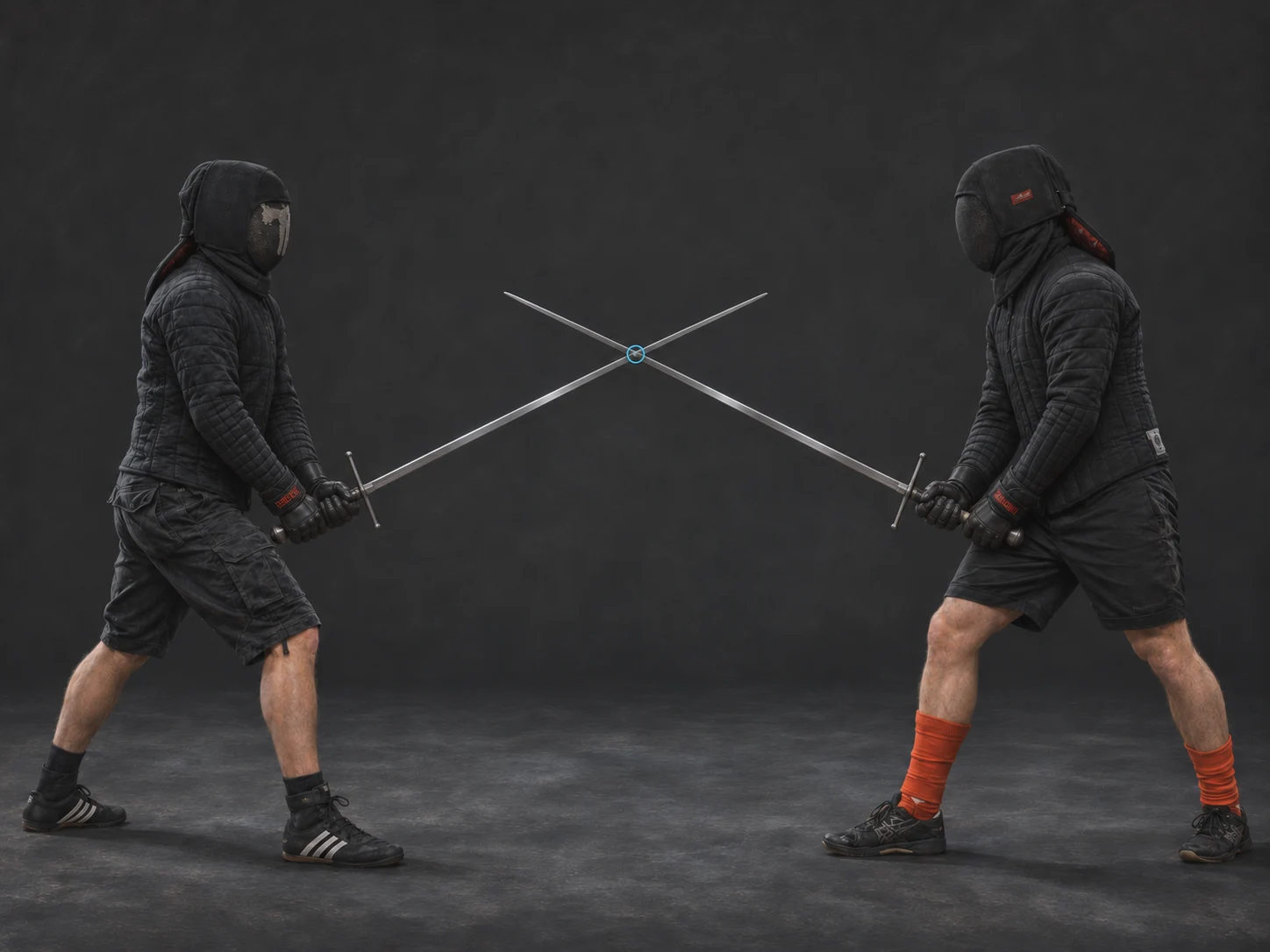
The blue ring marks contact about two-thirds along both blades, measured from the crossguard towards the point.
Try it
Practise the full and half backward steps on your own first. After each step, check which foot is in front. In your next partner session, start by mirroring just one type of step. Then have the leader alternate between full and half steps. Check the blade contact to see whether you've kept your distance, then swap roles.
We practise other steps in training too, such as the following step and the crossing step. For this distance exercise, full and half steps are enough. Focus on mirroring both cleanly and keeping the blade contact at roughly the same place.
Where these step sequences come from. There is no historical model for these specific sequences. For teaching at G-COMBAT, I have adapted movement principles from other weapon arts and built on the groundwork of other groups. These include Gladiatores Karlsruhe, founded by Sven Baumgarten.
Contact Henrik directly
Stuck on a movement or have a specific training question? Message me directly. I can give you a quick assessment by message. If you want to go deeper, review your technique on video or work one-on-one in the gym, we’ll put together a coaching package that fits.